
Cadmium-sulfide photoresistor
Build a relative light detector with a photoresistor, estimate a useful fixed divider resistor and understand why raw readings are not calibrated lux.
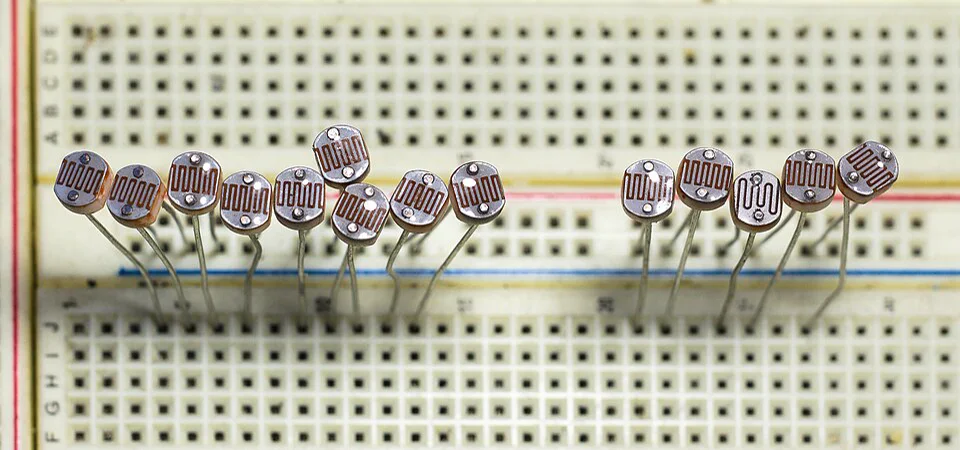

How it works
A cadmium-sulfide photocell changes resistance with illumination. The resistance typically decreases under brighter light, so it can be used to distinguish changes such as a room light turning on.
Typical wiring
Put a fixed resistor and photocell in series between a suitable supply and ground, then read their junction with an ADC. Reversing their order reverses the direction the measured voltage moves with brightness.
Interpreting readings
Two photocells can respond differently across both brightness and wavelength. A simple ADC count is useful for a threshold or trend; measuring absolute lux requires calibration and a suitable sensor response.
Specifications
| Parameter | Value or condition | Source |
|---|---|---|
| Terminals | Two nonpolarized leads | Adafruit |
| Output in divider | Analog voltage, affected by fixed-resistor choice and supply | Adafruit |
Compatibility and practice
Use an ADC and divider powered within your board’s analog input range.
Related components
Sources and datasheets
- Photocell measuring light · Adafruit