
Force-sensing resistor
Read a force-sensing resistor with a voltage divider and understand how loading area and repeatability constrain measurement.
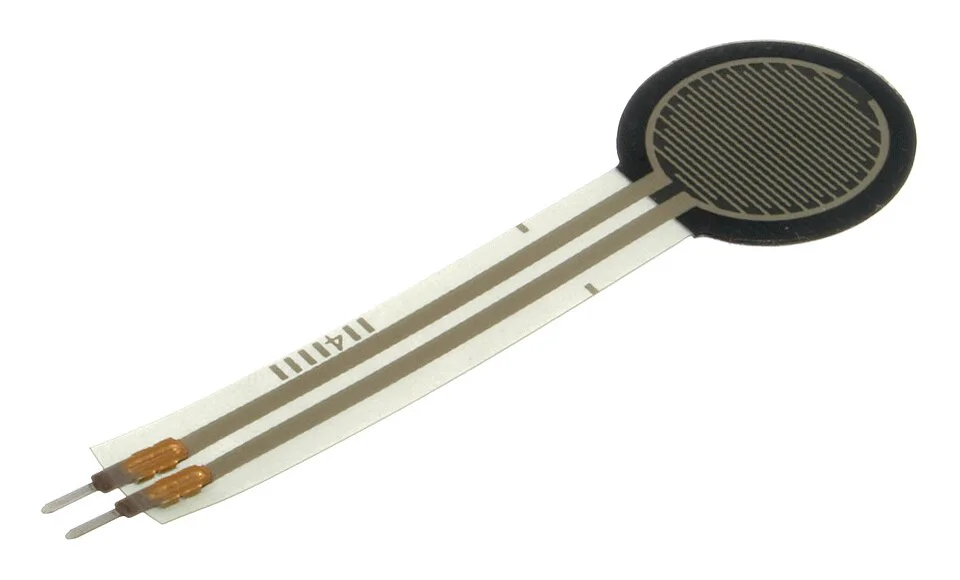

Behavior under load
Resistance decreases when force is applied across the active area. The response depends on the force distribution and mechanical construction around the sensing patch.
ADC measurement
Place the sensor in a divider with a fixed resistor. Choose that resistor based on the resistance near the force you want to distinguish. Take calibration measurements with the same pad and fixture you intend to use.
Common mistakes
Loading the very edge or bending the flex tail alters the response. The device is useful for touch or relative load measurements. Precision weighing usually calls for a load cell and an appropriate amplifier.
Specifications
| Parameter | Value or condition | Source |
|---|---|---|
| Representative active area | FSR 402: 14.68 mm diameter | Interlink Electronics |
| Output behavior | Resistance falls with applied force; curve depends on loading conditions | Interlink Electronics |
Compatibility and practice
Use a divider and calibrate the mounted assembly when numerical force matters.
Related components
Sources and datasheets
- FSR 400 Series Data Sheet · Interlink Electronics