
Pt100 platinum resistance thermometer
Measure a Pt100 with suitable excitation, account for lead resistance, and distinguish it from a 1 kΩ Pt1000 sensor.
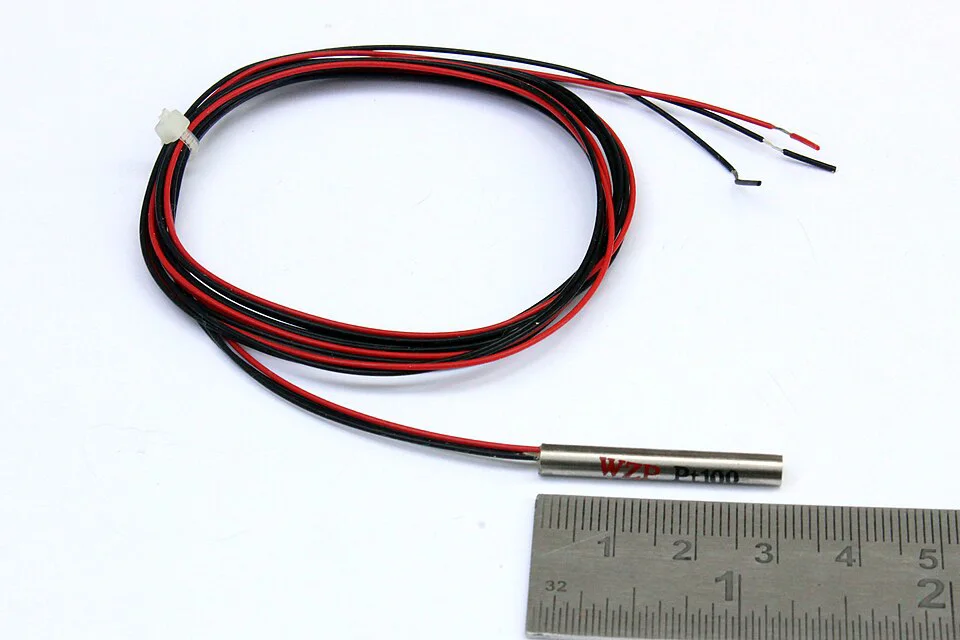

Resistance and temperature
A Pt100’s platinum sensing element changes resistance with temperature. Choose the documented conversion curve and sensor grade. It is a passive element and needs a measurement circuit to turn resistance into a useful reading.
Lead resistance
A two-wire measurement includes the leads. A three-wire circuit estimates the lead contribution under appropriate matching assumptions. Confirm which terminals reach the same end of the element before connecting it.
Probe and circuit limits
Check the allowable probe temperature and construction for the environment. Excessive measuring current can heat the element and change the reading, particularly in still air.
Specifications
| Parameter | Value or condition | Source |
|---|---|---|
| Nominal resistance | 100 Ω at 0 °C | Omega |
| Representative assembly | Omega PR-11 is available as a three-wire probe using the European curve | Omega |
Compatibility and practice
Use an RTD-compatible measurement circuit and confirm the wire count and sensor class.
Related components
Sources and datasheets
- General Purpose Pt100 Probe · Omega