
Piezoelectric buzzer
Tell a powered piezo buzzer from an externally driven sounder, then check the actual part’s polarity and drive specification.

How it works
An electric field deforms the piezoelectric element, moving the diaphragm. Repeated motion near its resonant frequency generates an audible signal. Housing and mounting can change perceived volume.
Buzzer versus sounder
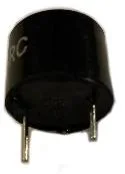
Some packaged buzzers include their oscillator and can sound from a specified DC supply. Other sounders need an external periodic signal or feedback circuit. A similar black plastic case does not identify which circuit is inside.
Practical wiring
Identify the part from its markings and use the datasheet drive circuit. Observe polarity where specified, and check supply or drive amplitude before connecting it to a controller. Use a driver circuit if the controller pin cannot supply what the component requires.
Specifications
| Parameter | Value or condition | Source |
|---|---|---|
| Key specification | Rated supply for an integrated buzzer; allowable drive amplitude for a sounder | Murata |
| Frequency selection | Check the marked part’s resonance and sound-pressure test conditions | Murata |
Compatibility and practice
Check for a built-in oscillator before connecting to a GPIO or external driver.