
LM386 audio power amplifier
Wire an LM386 speaker amplifier, choose its gain setting, and recognize layout problems that cause hum or oscillation.
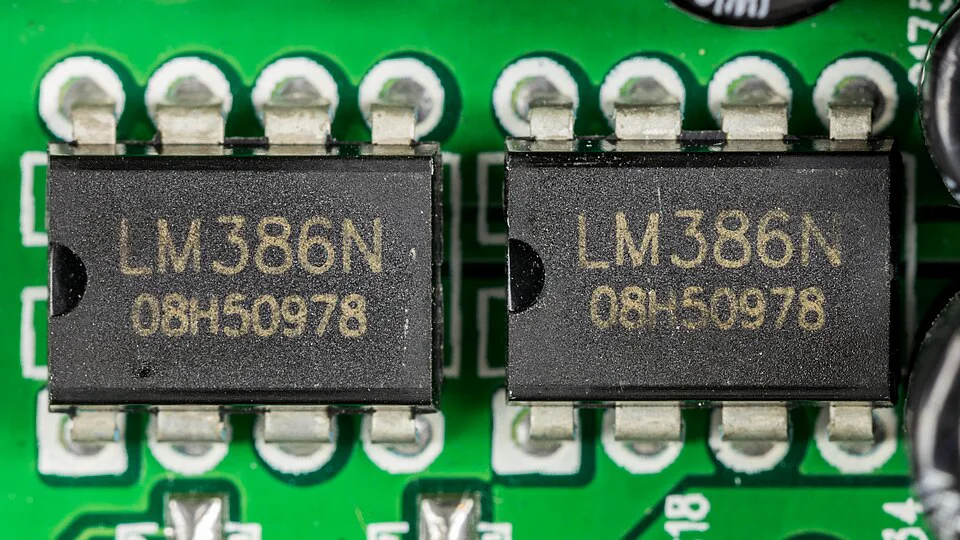

What it does
The LM386 supplies more output current than a standard small-signal op-amp buffer. Its single-supply output is internally biased, so the standard circuit couples it to the speaker through a capacitor.
Input and gain
Use an appropriate source level or volume control. Pins 1 and 8 let you change gain from the low default. Starting at default gain keeps amplification and noise easier to manage while debugging.
Help with noisy layouts
Place bypass capacitors close to the supply pins, keep speaker current out of the small-signal input ground path, and use the output stabilization parts in the datasheet example. Inspect the supply if a breadboard amplifier whistles or motorboats.
Specifications
| Parameter | Value or condition | Source |
|---|---|---|
| Default voltage gain | 20 V/V with gain pins open | Texas Instruments |
| Configurable gain | Up to 200 V/V using the documented gain network | Texas Instruments |
Compatibility and practice
Choose the documented supply and load for the suffix on the chip, and limit input amplitude.
Related components
Sources and datasheets
- LM386 Low Voltage Audio Power Amplifier · Texas Instruments