
Ferrite bead
Select a ferrite bead by impedance versus frequency and check how load current and nearby capacitors change the filter response.
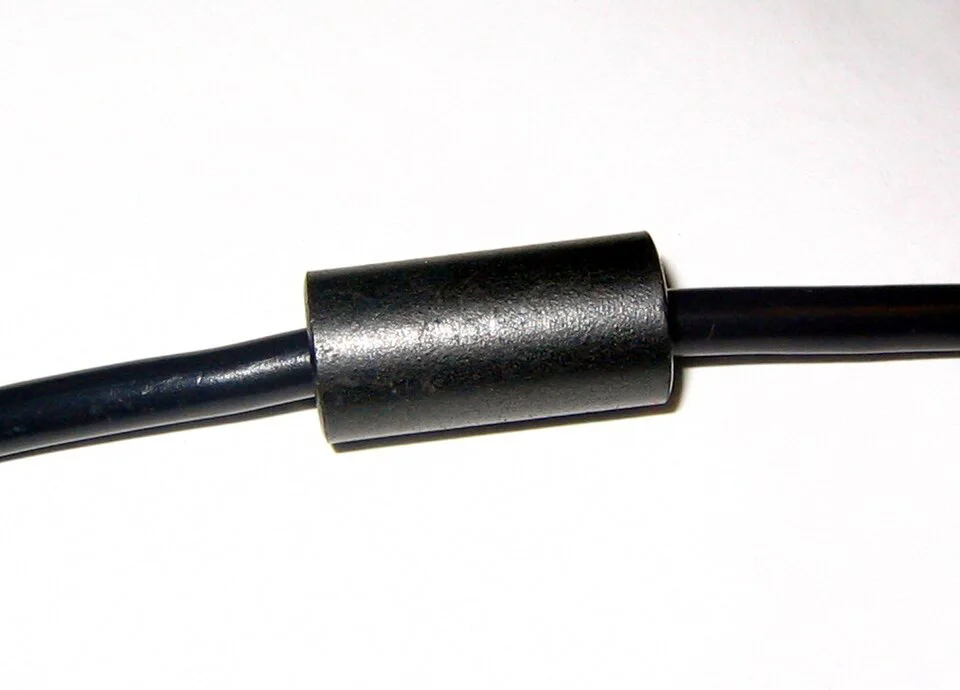

Frequency-dependent behavior
A bead presents relatively low impedance to DC and can behave as a lossy impedance in part of the RF range. Where it is mostly resistive, it dissipates high-frequency energy. A cable ferrite and power-rail chip bead have different mounting arrangements.
Current matters
Power-supply DC current can reduce effective impedance. A bead’s published current limit often describes heating rather than guaranteed high-frequency attenuation at that current.
Filter design
A bead and ceramic capacitor can resonate in some combinations. Check the impedance and bias curves and consider damping. Measure noise with the source and load connected before assuming the filter works.
Specifications
| Parameter | Value or condition | Source |
|---|---|---|
| Common evaluation parameters | Impedance versus frequency, DC resistance, DC bias behavior | Analog Devices |
| Physical example | Cable ferrite over a conductor; separate component series are available for PCB mounting | Analog Devices |
Compatibility and practice
Check the impedance curve, DC bias data and thermal rating before selecting a bead.
Related components
Sources and datasheets
- Ferrite Bead Demystified (AN-1368) · Analog Devices