
Aluminum electrolytic capacitor
Read the markings on an aluminum electrolytic capacitor and check polarity, ripple current, voltage and temperature for low-voltage power filtering.
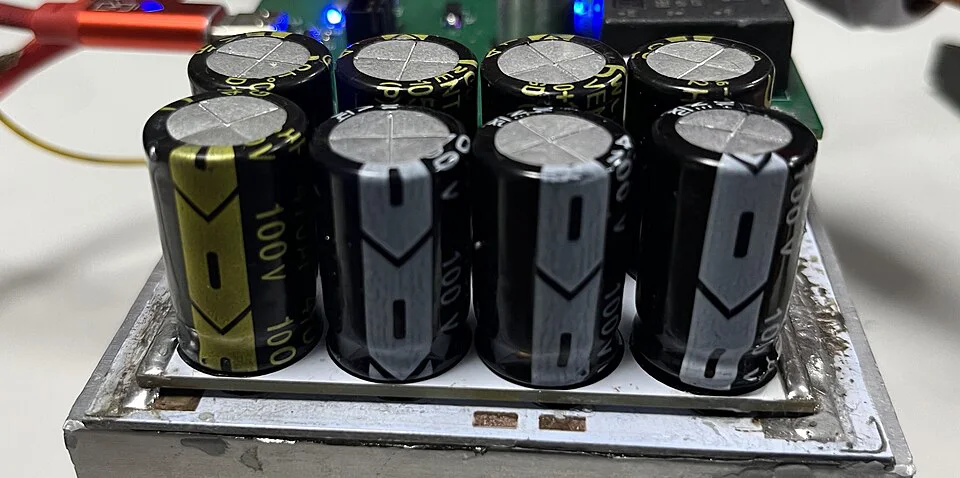

Overview
A wet aluminum electrolytic uses a thin oxide layer as its dielectric. It can provide substantial capacitance in a small volume, making it useful as bulk storage on supply rails.
Polarity and placement
Most general-purpose parts have a polarity stripe identifying the negative terminal; confirm the exact marking. Connect it across the appropriate low-voltage power rail with the correct polarity and keep the combined DC and ripple peaks within the rating.
Interpreting ratings
Ripple current heats the capacitor through its equivalent series resistance. Temperature strongly affects lifetime. A replacement with the same capacitance and voltage may still be unsuitable if its ripple capability or ESR differs.
Specifications
| Parameter | Value or condition | Source |
|---|---|---|
| Capacitance | Rated part by part and typically printed on the sleeve | Nichicon |
| Ripple limit | Specified by series, temperature and test frequency | Nichicon |
Compatibility and practice
Observe polarity, voltage and ripple ratings; no firmware is needed.